Step and Repeat Backdrops · Red Carpet Events
Red Carpet and Premiere Backdrops Built for the Moment That Matters.
Every photo from your red carpet event will feature your backdrop. Media coverage, social posts, event recaps, press archives, the backdrop is in all of it. It needs to be perfect before the first guest walks.



Why it matters
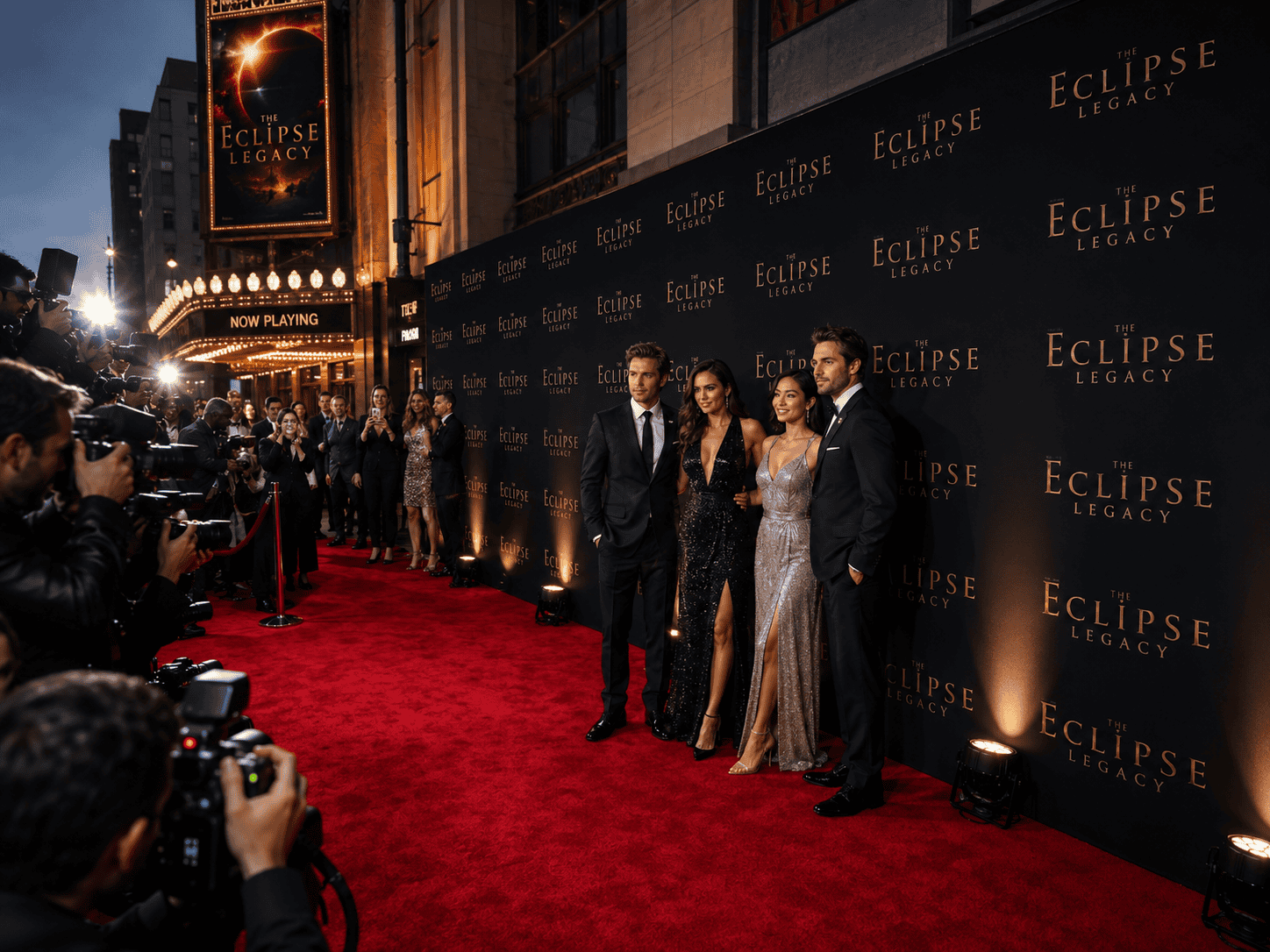
A red carpet event generates more branded photography per hour than almost any other format. Every guest photo, every media shot, every celebrity or talent photo goes through your backdrop. That is not an opportunity to gamble on print quality or color accuracy.
The photo line setup
How to Set Up a Red Carpet Photo Line
Most people think about the backdrop and forget that the backdrop is one part of a system. How the photo line flows, where the velvet rope positions guests, how far back media photographers stand, and how the backdrop integrates with lighting all affect the final result in every photo. Here is how a professional red carpet photo line comes together.
The backdrop anchors everything else. It should be positioned against a wall or in a space with at least 8 to 10 feet of clear depth in front of it, this is the distance between the backdrop and where guests will stand. Closer than 6 feet and the backdrop will appear out of focus in photos. Further than 12 feet and it starts to feel disconnected from the subject.
Ropes on each side of the photo zone keep guests centered in front of the backdrop and prevent the common problem of people standing at the edge of the frame where logos are cut off. Position ropes so the usable standing zone is no wider than 60 to 70% of the backdrop width, this ensures logos always appear behind subjects in any photo crop.
Media photographers need a consistent shooting distance. Too close and they cannot fit the backdrop fully behind a group. Too far and flash starts to create problems. A camera distance of 10 to 15 feet from the backdrop works for most events, this captures 2 to 4 people with the full backdrop visible behind them in a standard press photo crop.
Uneven lighting creates hot spots and shadows across logos, a problem that shows up in every photo and cannot be fixed in editing. Two softbox lights positioned at 45 degrees on each side of the backdrop at approximately the same height as the backdrop center creates even coverage without harsh shadows. Avoid backlighting the backdrop from behind, it creates glow that washes out logo detail.
The person managing talent or guests through the photo line controls the pace. Brief them on where exactly to position each person in front of the backdrop. not just "in front of it" but at the specific centered zone where logos frame the subject correctly. This small detail is the difference between professional photo coverage and 200 photos with someone's head covering your main logo.


Sizing guide
What Size Red Carpet Backdrop Do You Need?
Standard sizes
For most red carpet events. 15 to 20 feet wide by 8 feet tall is the standard. Major premieres with broadcast coverage and multiple simultaneous talent typically use 20 feet wide by 10 feet tall. Smaller events, awards nights, brand activations, galas, often work well with 12 feet wide by 8 feet tall.
| Event Type | Recommended Size | People Per Photo | Notes |
|---|---|---|---|
| Awards night or gala | 12–15 ft wide · 8 ft tall | 2–4 people | Couples and small groups, standard photo line |
| Indie or regional premiere | 15 ft wide · 8–10 ft tall | 3–5 people | Multiple talent, media photographers present |
| Major studio premiere | 20 ft wide · 10 ft tall | 4–8 people | Broadcast coverage, multiple camera angles |
| Brand activation red carpet | 10–12 ft wide · 8 ft tall | 1–3 people | Consumer-facing photo ops, social sharing |
| Fashion show or launch | 15–20 ft wide · 8 ft tall | Variable | Runway flow, media wall format |
The most common mistake is ordering too narrow, a backdrop that looks large in a warehouse looks small on a red carpet with photographers shooting from 15 feet back. When in doubt, size up. A wider backdrop is always better than one that gets cropped out of press photos.
Design considerations
How Logo Repetition Works on a Red Carpet Backdrop
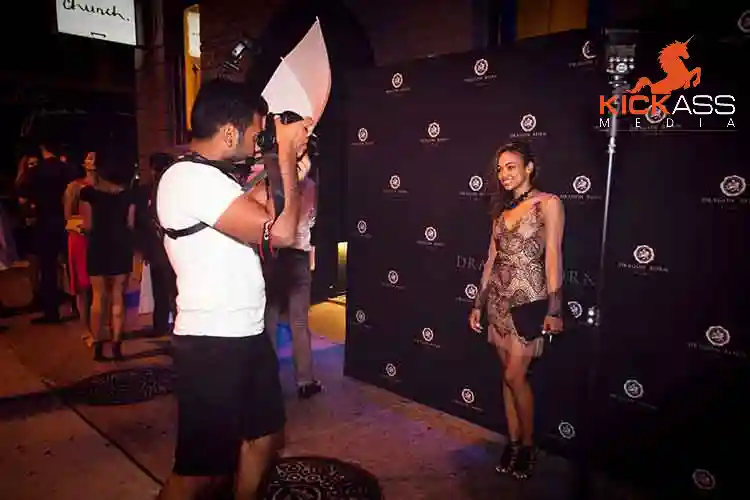
The repeating pattern on a step and repeat backdrop is designed with a specific purpose: no matter where a photo is cropped, at least one complete logo appears somewhere in the frame. On a red carpet where photographers shoot at varying angles, distances, and speeds, this is what makes the backdrop function as a branding tool rather than just a decorative background.
For most red carpet events, logos should repeat every 18 to 24 inches horizontally. Tighter spacing (15 to 18 inches) works better for wide shots where many people are photographed simultaneously. Wider spacing (24 to 30 inches) suits events where photos tend to be tighter on individual talent.
When multiple sponsors share the backdrop, the layout needs to ensure every sponsor appears in every photo crop, not just the primary sponsor. A balanced grid pattern alternating sponsor logos ensures no brand is consistently cut out of shots. Our designer reviews this before anything goes to print.
A logo that reads clearly at 3 inches on a laptop can look thin and illegible printed at 3 inches on a 20-foot backdrop under flash photography. Our designer reviews every file at actual print dimensions to confirm logos remain sharp, legible, and on-brand at the sizes they will actually appear on the physical backdrop.
Black and deep color backgrounds perform best on red carpets, they absorb light rather than reflect it, which prevents hot spots from flash photography and makes logos pop more clearly in photos. Light-colored backdrops can wash out under heavy flash.
Frame options
Which Frame Is Right for a Red Carpet Event?
The frame you choose affects how the backdrop looks in photos, how quickly it sets up, and whether it can handle the demands of a high-traffic event. Here are the three options and when each is the right choice.
The accordion-style frame that opens in minutes without tools. Fabric is stretched across the frame for a wrinkle-free, taut finish that photographs cleanly under any lighting. Sets up in under 10 minutes, ideal when event timelines are tight. Lightweight enough to move and reposition during setup.
Best for: Awards nights, galas, brand activations, indie premieres, any event where setup speed matters.
Double-sided fabric construction that completely hides the frame on both sides. No visible frame edges in photos from any angle. Ideal for events where cameras may be positioned to the side of the backdrop or where the back of the backdrop is visible to guests in the venue.
Best for: Mid-to-high profile premieres, events with cameras shooting from multiple angles, any setup where frame edges would be visible in coverage.
The cleanest finish available. Stitch lines are completely hidden inside the frame, the backdrop presents as a seamless surface with zero visible seams at any distance. The standard for major studio premieres, broadcast events, and high-profile red carpets where the backdrop will be seen in professional photography and broadcast media.
Best for: Major premieres, broadcast events, high-profile red carpets, any event where the backdrop is photographed professionally at close range.
For a full comparison including setup time, portability, and best-for recommendations, see our complete frame guide.
Before you order
Two Questions to Ask Any Backdrop Supplier
Red carpet events do not allow for mistakes. Here are the two supplier questions that matter most before placing an order.
Most suppliers approve artwork on screen and ship. The problem: screen colors are RGB. Print colors are CMYK. The conversion shifts colors, sometimes slightly, sometimes dramatically. For a brand with specific Pantone colors, a backdrop that arrives with colors visibly off from your standards is a liability in every photo taken that night. If the supplier did not provide a physical proof, you accepted whatever came off their press.
What to look for: A supplier who prints a physical swatch for you to approve before production begins. You hold it in your hands and compare it to your brand standards. If it does not match, you say so before the full order runs.
A backdrop frame used at a red carpet event is under stress, heavy fabric, extended hours, repeated setup and teardown. Most supplier warranties run 90 days to one year. A frame that fails at your third event is not a savings. At a live event with cameras rolling and talent on the carpet, a frame problem is a catastrophe with no time to fix it.
What to look for: A written lifetime warranty covering replacement parts. Specifically ask: if a frame component breaks two years from now, what is the process? The answer reveals whether the supplier sees this as a long-term relationship or a one-time transaction.


What our clients say
Brands and Agencies Who've Done It Right

Every order backed by
Every KA Media red carpet backdrop goes through three verification phases before it ships. The two pitfalls above are specifically what this system is designed to prevent.
Our designer checks your files at actual print dimensions before production. Logo pixelation, distortion, multi-sponsor layout issues, and stitch line placement are all reviewed before anything goes to print.
We print a physical swatch to verify your brand tones before the full production run. You approve the exact color in your hands. If it does not match, we reprint at no cost.
Equipment is calibrated before your job runs. Where needed, a proof is sent for your approval before the full production run begins.
Common questions
Frequently Asked Questions
Explore by event type
Step and Repeat Backdrops by Event Type
Every event has different requirements. Find the right backdrop for yours.

"My team helps you be remembered for the right reasons."
Ready to Make Your Red Carpet Look Flawless?
Tell us about your event, venue, size, how many guests, whether you have broadcast coverage. We will recommend the right backdrop and send a free swatch before anything goes to print.

Let's Talk About
Your Event
Tell us about your event and we will recommend the right backdrop and send a free swatch.